

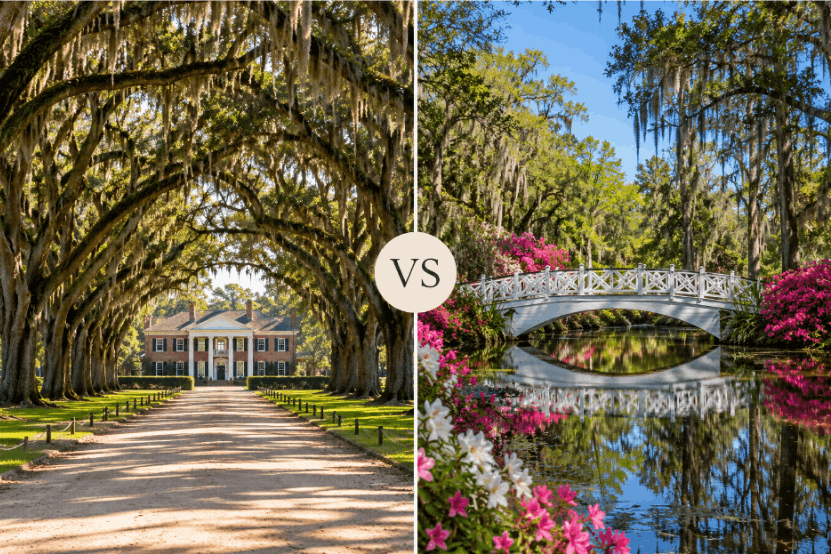
Most visitors have time for one plantation, not three, and Boone Hall and Magnolia are the two names that come up most. They're genuinely different places, so the right choice depends on what you actually want from the day.
Here's the honest comparison: history, gardens, photos, families, how long each takes, and how they fit into a trip based downtown in Charleston, SC.
If you want sweeping historic gardens, nature, and a visit that can easily fill half a day, Magnolia is the stronger fit. If the Avenue of Oaks, the working agricultural landscape, original cabins that housed enslaved people, and live Gullah presentations matter most to you, Boone Hall may fit better.
Both sit outside downtown in different directions, so either one works best as a dedicated half-day outing. Allow roughly two to three hours for Boone Hall and three to four hours for Magnolia if you want to explore the gardens and add a couple of its tours.
| If you care most about… | Better fit |
|---|---|
| Historic gardens | Magnolia |
| Avenue of Oaks | Boone Hall |
| Original cabins that housed enslaved people | Boone Hall |
| Dedicated slavery-to-freedom tour | Magnolia (included with admission) |
| Live Gullah cultural presentation | Boone Hall |
| Wildlife and nature | Magnolia |
| Young-child outdoor activities | Magnolia |
| Working agricultural landscape | Boone Hall |
| Gullah Geechee heritage as the main focus | Consider McLeod instead |
The Case for Boone Hall
Boone Hall is the one you've probably seen in photos without knowing it.
The Avenue of Oaks is Boone Hall's best-known visual feature, creating a long live-oak approach to the property. Boone Hall traces the avenue to 1743, when the planting of live oaks along the approach began. It's a working farm too, at 1235 Long Point Road in Mount Pleasant, so there's often something growing or being harvested. One honest note: the plantation home visitors see today is not an antebellum structure. Boone Hall says the current mansion was built in 1936, so if you're expecting an original period mansion, set that expectation now.
Where Boone Hall stands out is how it incorporates the history of slavery into the visit. The site has nine original brick cabins that housed enslaved people, with exhibits, and general admission also includes its live "Exploring the Gullah Culture" presentation, which focuses on the development of Gullah culture in the Lowcountry. Together, the cabins, exhibits, history talks and Gullah presentation make this history a substantial part of the Boone Hall visit. You can confirm current hours and what's included on Boone Hall's official tours and admission page.
The Case for Magnolia
Magnolia Plantation is, first and foremost, about the gardens.
At 3550 Ashley River Road, its historic gardens date to the 19th century and were opened to the public shortly after the Civil War. Today, the gardens, waterways and natural areas are the property's biggest draw for many visitors. Spring can bring prominent displays of azaleas, camellias and other seasonal blooms, although timing varies with conditions. The landscape also includes bridges, waterways and the property's recognizable white bridge.
Beyond the historic gardens, admission currently includes the Wildlife Center and the self-guided Audubon Swamp Garden. A Nature Train is available for an additional fee, while the Wildlife Boat is seasonal, weather-dependent and also costs extra. Magnolia Plantation & Gardens is open seven days a week, but operating hours and tour availability can vary. Check the official daily schedule before visiting for the current hours and tour times.
Magnolia also addresses the lives of the people who were enslaved there through its 45-minute "From Slavery to Freedom" Tour, which explores African American life from slavery through Reconstruction. The tour is currently included with general admission, but visitors need to obtain a same-day tour ticket and availability is limited.
Which Is Better for Each Type of Visitor
Here's how they tend to sort out by what matters most to you.
- For the Avenue of Oaks photo: Boone Hall. Its long live-oak approach is one of the property's defining visual features.
- For gardens and nature: Magnolia, easily. Its historic gardens and natural areas are the main draw.
- For interpreting the history of enslavement: Both offer dedicated interpretation in different formats. Boone Hall includes nine original cabins that housed enslaved people, its Black History in America exhibit and live Gullah presentations; Magnolia includes its 45-minute "From Slavery to Freedom" tour.
- For young families: Magnolia offers several family-friendly outdoor options, including the Wildlife Center and Nature Train. Note its House Tour currently has a minimum age of seven.
- For a working-farm feel: Boone Hall.
- For spring blooms: Magnolia is the stronger choice, but check its current "What's in Bloom" information before planning a trip around a particular flower.
How Far Are They, and Can You Do Both?
This is where geography makes your decision for you.
Boone Hall is at 1235 Long Point Road in Mount Pleasant, about eight miles from downtown Charleston. Magnolia is at 3550 Ashley River Road, west of downtown along the Ashley River corridor. Because the two properties sit on different sides of the Charleston area, combining them creates considerably more driving than choosing one and returning downtown afterward. Check current traffic and route times on the day of your visit.
You can technically do both in one day, but it makes for a long, rushed day. For most visitors, choosing one property and giving it a dedicated half day will make for a less rushed experience. Plan on a few hours rather than trying to squeeze either stop into a tight schedule. Magnolia currently recommends allowing three to four hours if you want to explore the gardens and experience a couple of its guided tours.
A Note on History, and a Third Option
Both sites interpret the history of enslavement alongside their other visitor experiences, and both should be approached as places where enslaved people lived and labored, not simply as historic houses or scenic landscapes.
If the history of enslavement and Gullah Geechee heritage is your primary reason for visiting, consider McLeod Plantation Historic Site on James Island as a third option. Charleston County Parks describes McLeod as a 37-acre Gullah Geechee heritage site, with interpretation covering slavery, emancipation and the lives of the people who lived and worked there. Our guide to Gullah Geechee culture in Charleston covers McLeod and how to engage with this history thoughtfully.
Frequently Asked Questions
Neither is universally better. Boone Hall may suit you more if the Avenue of Oaks, working agricultural landscape, original cabins and live Gullah presentation are priorities. Magnolia is the stronger fit for historic gardens, nature and a longer garden-focused visit.
You can, but the properties are in different directions from downtown Charleston, so visiting both adds significant driving and leaves less time at each site. For most visitors, choosing one makes for a more relaxed half-day outing.
Boone Hall is in Mount Pleasant, about eight miles from downtown Charleston. Magnolia is at 3550 Ashley River Road west of downtown. Driving time to either varies with Charleston-area traffic, so check your route before leaving.
Allow a few hours for either visit. Magnolia currently recommends three to four hours to explore the gardens and experience a couple of its guided tours, so it can easily become a half-day outing.
Boone Hall includes nine original brick cabins that housed enslaved people, its Black History in America exhibit and live "Exploring the Gullah Culture" presentations. Magnolia includes a dedicated "From Slavery to Freedom" tour. If Gullah Geechee heritage and the lives of enslaved people and their descendants are your primary focus, also consider McLeod Plantation Historic Site, a dedicated Gullah Geechee heritage site on James Island.
Plan Your Charleston Plantation Day
Whichever site you choose, check current opening hours, tour availability and traffic before leaving Charleston. Starting early gives you more flexibility for scheduled tours and leaves time to return to the city for the rest of your day. If Parson Inn is your Charleston base, you can explore our suites or check availability for your dates.